Introduction
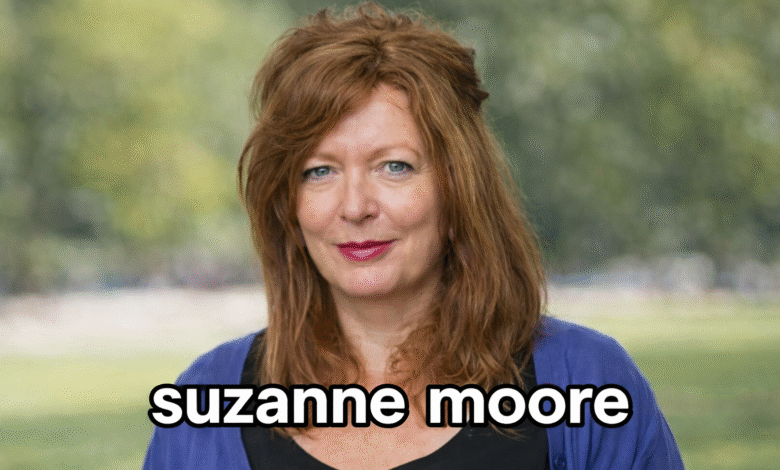
Suzanne Moore is one of the most influential and outspoken journalists in modern British media. Known for her sharp intellect, uncompromising tone, and cultural insight, she has spent decades shaping public debate through opinion columns, cultural criticism, and political commentary. Her writing is admired for its honesty and depth, while at the same time it has sparked controversy and strong reactions across the political spectrum.
Suzanne Moore’s career reflects both the power and the risk of independent journalism. She has built a reputation for saying what she believes, even when it is unpopular. This combination of courage and conviction has made her a respected figure to many readers and a challenging presence for institutions and colleagues alike.
Quick Bio: Suzanne Moore
| Profile Detail | Information |
|---|---|
| Full Name | Suzanne Lynn Moore |
| Date of Birth | 17 July 1958 |
| Birthplace | Ipswich, Suffolk, England |
| Nationality | British |
| Profession | Journalist, Columnist |
| Education | Northgate Grammar School; Middlesex Polytechnic |
| Children | Three daughters |
| Known For | Political and cultural commentary |
| Awards | Orwell Prize for Journalism (2019) |
Early Life and Background
Suzanne Moore was born and raised in Ipswich, Suffolk, where her early life was shaped by working-class realities and family complexity. Her parents separated during her childhood, an experience that later influenced her writing about class, independence, and social power. These formative years helped build her resilience and sharpen her awareness of inequality and cultural tension.
Leaving home as a teenager, she experienced early independence that forced her to mature quickly. Before entering higher education, she worked a range of jobs, gaining real-world experience that later grounded her journalism. This period gave her an authentic voice that resonates strongly with readers who value lived experience over abstract theory.
Education and Intellectual Formation
Suzanne Moore attended Northgate Grammar School for Girls, where her academic ability became evident. She later studied at Middlesex Polytechnic, initially focusing on psychology before moving into cultural studies. This shift proved decisive, equipping her with analytical tools to explore politics, media, and society through a critical lens.
After completing her degree, she began doctoral research but ultimately chose journalism over academia. This decision marked the beginning of a career defined not by theory alone, but by direct engagement with public life. Her academic background continues to inform her work, giving her writing intellectual depth without sacrificing accessibility.
The Start of a Journalism Career
Suzanne Moore’s professional career began in the world of political and cultural magazines. One of her earliest significant roles was at Marxism Today, where she worked as a cultural editor. This position placed her at the heart of left-wing intellectual debate during a period of major political change in Britain.
Her early work demonstrated a clear ability to connect culture with politics. She also became a film critic for the New Statesman, further expanding her influence and sharpening her critical voice. These early roles laid the foundation for her later success in mainstream national newspapers.
Rise as a National Columnist
Suzanne Moore went on to write for many major British newspapers, establishing herself as a prominent national columnist. Her work appeared in outlets such as The Independent, Daily Mail, Mail on Sunday, and most notably The Guardian. Over time, her columns became known for their clarity, confidence, and willingness to confront difficult topics.
At The Guardian, she developed a wide readership and became one of the paper’s most recognizable voices. Her writing covered politics, feminism, class, and cultural identity. While many praised her honesty and intelligence, others criticized her for being confrontational or provocative, illustrating the divisive power of strong opinion writing.
Controversy, Conflict, and Departure
A defining moment in Suzanne Moore’s career came during her later years at The Guardian. A column addressing women’s rights and gender debates sparked intense internal and public criticism. The episode exposed deep divisions within media institutions over freedom of expression and ideological boundaries.
In 2020, Suzanne Moore left The Guardian, marking the end of a long and influential chapter. For supporters, her departure symbolized a loss of editorial independence in mainstream journalism. For critics, it represented accountability. This moment highlighted both the positive and negative consequences of fearless journalism in a polarized media environment.
Later Career and Continued Influence
After leaving The Guardian, Suzanne Moore continued her journalism career through other platforms and publications. She maintained her role as a public intellectual, writing opinion pieces and engaging in cultural debate. Her later work shows a consistent commitment to independence and clarity of thought.
Rather than stepping back, she reinforced her identity as an individual voice outside institutional constraints. This phase of her career demonstrates adaptability and resilience, proving that influence in journalism does not depend on a single platform but on credibility and conviction.
Writing Style and Core Themes
Suzanne Moore’s writing style is direct, analytical, and emotionally grounded. She blends personal experience with political insight, making complex issues understandable without oversimplifying them. Her columns often explore feminism, class struggle, power structures, and cultural change.
A positive aspect of her work is its intellectual honesty and refusal to follow trends. A negative perception, voiced by critics, is that her tone can be uncompromising and polarizing. Together, these qualities define a journalist who values truth over comfort and debate over consensus.
Awards and Recognition
In 2019, Suzanne Moore received the Orwell Prize for Journalism, one of the most prestigious awards in British media. This recognition affirmed her impact and credibility as a political writer and commentator. The award highlighted her ability to combine strong opinion with rigorous analysis.
Her recognition by such an institution confirms that, regardless of controversy, her contribution to journalism is significant and lasting. Awards like this reinforce her status as a major figure in British intellectual life.
Legacy and Impact
Suzanne Moore’s legacy lies in her fearless approach to journalism. She has shown that opinion writing can still be bold, thoughtful, and socially relevant. Her career demonstrates the power of an individual voice in shaping national conversations, even in the face of resistance.
She will be remembered as a journalist who challenged institutions, questioned assumptions, and refused to dilute her views. While her work continues to divide opinion, its influence on British media and public debate is undeniable.
Conclusion
Suzanne Moore represents both the strength and the tension of modern journalism. Her career is marked by courage, controversy, and intellectual rigor. She has inspired admiration and criticism in equal measure, proving that meaningful journalism often comes at a personal and professional cost.
In an era of cautious commentary, Suzanne Moore stands as an example of what it means to write with conviction. Her story is not only about journalism but about the enduring value of independent thought in a complex and changing society.
Frequently Asked Questions (FAQ)
Who is Suzanne Moore?
Suzanne Moore is a British journalist and columnist known for political, cultural, and feminist commentary.
What is Suzanne Moore famous for?
She is famous for her long career as a national columnist and for her outspoken, independent opinions.
Where was Suzanne Moore born?
She was born in Ipswich, Suffolk, England.
Has Suzanne Moore won any awards?
Yes, she won the Orwell Prize for Journalism in 2019.
What topics does Suzanne Moore write about?
Her work focuses on politics, culture, feminism, class, and social power.