Owning a home in West London often turns us into amateur interior designers. One minute we’re buying a coffee, the next we’re convincing ourselves that a handcrafted side table is exactly what the living room needs.
But carpets rarely help us keep pace with that standard. You hoover them and spritz a little lavender air freshener. Yet the moment afternoon sunlight cuts across the room, you spot a cloud of dust motes swirling through the air around them like a miniature snow globe.
If you live in Chiswick, this isn’t your imagination, and we’ll explain exactly why this happens and what to do about it.
Unique Texture of Chiswick Carpets
Walk into almost any Chiswick home, and you’ll notice a certain taste in flooring. Many prefer traditional Axminster and Wilton weaves. They project an air of luxury, with the kind of timeless presence that makes you wonder if they’ve been there since 1987.
These textured, patterned carpets are genuinely beautiful. Unfortunately, they’re also remarkably effective at trapping dust.
The tight, looped or cut pile of these traditional weaves creates thousands of microscopic pockets where dust can easily settle.
Unlike hard flooring, which easily shows dust and debris, textured carpet conceals these particles entirely.
Colour and Pattern Impact
We love our sophisticated neutral tones, elegant greys, and classic William Morris style patterns. These aesthetic choices are fantastic for creating a calm, cohesive interior design.
They’re also spectacularly efficient at camouflaging weeks of accumulated household grime.
A spotty or intricate pattern blends seamlessly with grey flakes of dead skin. The subtle heathered wool tones match the outdoor dust remarkably well. You’ll glance down and assume everything is clean because nothing stands out clearly.
This visual trick of light creates a false sense of security for busy homeowners. Over time, it becomes easy to overlook the gradual build-up of dust, and weeks can pass before you realise how much dust has accumulated beneath the surface.
Lighter carpets aren’t off the hook either. Cream and oatmeal tones show footprints immediately but tend to mask the finer particles that settle deep into the pile.
Fibre Density and Dust Retention
High-quality carpets often feature a dense pile that creates the soft, cushioned feel many homeowners enjoy.
However, that same density can make it easier for dust, dirt, and other particles to become trapped within the fibres. As a result, dust may be more difficult to remove completely through routine vacuuming alone.
Wool carpets, which are common in Chiswick given the area’s general preference for natural materials, are particularly effective dust retainers.
Wool fibres have microscopic scales that can trap fine particles within the pile, making them more difficult to remove. It’s actually impressive, if you think about it—in the most frustrating way possible.
Synthetic carpets have their drawbacks, too. Nylon and polypropylene develop static charges over time, which effectively turns the carpet into a low-level electromagnetic trap for dust and pet dander, and whatever else has been drifting through your air.
This is precisely why carpet cleaning, Chiswick-wide, has evolved from an occasional luxury into an essential part of standard home maintenance. When you’re juggling a packed schedule, it makes sense to hand the heavy lifting over to specialists.
One dedicated booking means one less thing to worry about.
Carpet Placement and Dust Accumulation
Where you put a carpet matters just as much as what it’s made of.
And in Chiswick’s Victorian and Edwardian terraces—with their long hallways and bay-windowed front rooms—carpets often occupy the areas where dust accumulates fastest.
Hallways funnel foot traffic and airborne particles in equal measure. Every time a door opens, air movement can carry dust and other particles further into the home. Your carpet is simply there to catch it all.
The areas under the stairs and in the corners are another common household blind spot. We simply forget to look there, allowing dust to settle and accumulate over time.
It doesn’t help that most vacuum attachments are physically incapable of reaching into those tight right angles.
Effective Cleaning Techniques
Dragging your rugs out to the garden for a vigorous shake is no longer a viable modern option. We need a more sophisticated approach to clean and refresh our beautiful West London floor coverings.
Here are some of the most reliable methods to help restore your flooring.
The Slow and Multi-Directional Vacuum Method
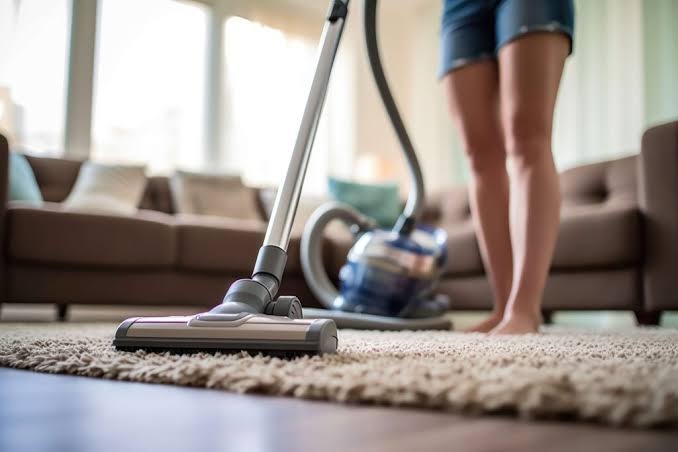
Rushing through your chores at lightning speed accomplishes absolutely nothing of value. You need to move the machine deliberately slowly to allow airflow to work. Vacuum in one direction, then repeat the process at a right angle to the first pass.
This cross-hatch pattern reaches into the fibre twists from every single possible angle, loosening the stubborn particles that hide behind the bent wool threads.
But in order for this routine to work, make sure to commit to it at least twice every single week.
Regular Deep Steam Extraction
The combination of heat, water, and extraction helps loosen greasy residues from the carpet fibres.
The high temperature breaks the chemical bond between the grease and the wool. It also flushes the dirt from deep within the carpet pile and backing.
Schedule this heavy-duty treatment at least twice a year for the best results. This will help remove the hidden allergens that normal household suction typically doesn’t reach. Your home will feel instantly fresher once that trapped dirt and debris are removed.
Encapsulation Cleaning
This low-moisture technique relies on advanced polymers to capture deeply embedded dirt particles. You’ll need to hire professionals for this one, who’ll apply a specialised solution directly to the carpet pile, where it’ll surround the microscopic debris.
As it dries, it’ll crystallise into tiny, removable capsules that release the grit from the fibres. A heavy-duty commercial vacuuming then completely removes the encapsulated dirt from the affected area.
Professional Agitation and Grooming
This process relies on specialised machinery with counter-rotating brushes to manually lift the flattened pile.
This deep agitation coaxes the dense layers open to release trapped grit. It stops sharp particles from slowly sawing away at the fibre bases.
A final grooming rake leaves the threads standing upright and fully refreshed. This restores that beautiful, bouncy showroom look to your beloved living space.
Conclusion
Congratulations! Your days of fighting the hidden dust are officially over, leaving you with a beautifully revived carpet that feels as fresh as the day it was laid.
Now it’s time to put these techniques to the test—kick off your shoes, start your new routine today, and feel the difference for yourself.