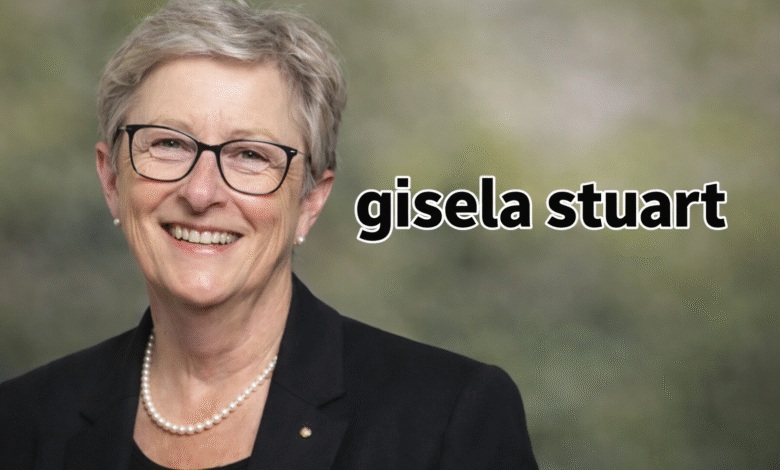
gisela stuart: A Powerful Journey of Principle, Politics, and Public Service

Introduction
Gisela Stuart is one of the most distinctive figures in modern British politics. Her story is not only about holding office, but about conviction, independence, and the courage to challenge political comfort zones. From her early life in Germany to becoming a Member of Parliament and later a life peer in the House of Lords, her career reflects resilience and intellectual depth.
Her political journey contains both positive and negative moments. On one hand, she broke electoral barriers and rose to senior public roles. On the other, her strong pro-Brexit stance placed her at odds with much of her own party. This tension between loyalty and principle defines her public legacy and makes her a compelling figure in British political history.
Quick Bio: Gisela Stuart
| Detail | Information |
|---|---|
| Full Name | Gisela Stuart (née Gisela Gschaider) |
| Title | Baroness Stuart of Edgbaston |
| Date of Birth | 26 November 1955 |
| Place of Birth | Velden, Bavaria, West Germany |
| Nationality | British (naturalised), German-born |
| Religion | Roman Catholic |
| Political Background | Labour MP, later Crossbench Peer |
| Years Active | 1997 – present |
| Known For | Brexit Vote Leave Chair, Civil Service Commissioner |
Early Life and Background
Gisela Stuart was born in Bavaria, West Germany, and raised in a structured education system that emphasised discipline and vocational skills. Her early years shaped her pragmatic worldview and appreciation for institutions, order, and responsibility. After completing secondary education, she undertook an apprenticeship in bookselling, which exposed her to ideas, debate, and international culture.
In 1974, she moved to the United Kingdom, a decision that marked a defining shift in her life. Initially motivated by education and language development, she gradually embedded herself in British academic and professional life. This cross-cultural experience later became central to her political identity, particularly in debates about sovereignty and national governance.
Education and Academic Development
After arriving in Britain, Gisela Stuart studied Business Studies, gaining an understanding of organisational structures and economic systems. Her academic ambitions later turned toward law, and she completed an LLB degree through the University of London. This legal training strengthened her analytical thinking and policy interpretation skills.
She later began doctoral research in trust law while teaching law at college level. Although the doctorate was not completed, this period laid the foundation for her deep engagement with constitutional, legal, and governance issues. Her academic background distinguished her from many career politicians by grounding her arguments in legal reasoning rather than rhetoric.
Early Career Before Politics
Before entering frontline politics, Stuart worked in the publishing and education sectors. Notably, she served as Deputy Director of the London Book Fair, a role that required diplomacy, organisation, and international coordination. This professional experience enhanced her administrative competence and global outlook.
Teaching law also sharpened her ability to communicate complex ideas clearly, a skill that later became visible in parliamentary debates. These early roles formed the professional bridge between her academic training and her eventual political career.
Entry into British Politics
Gisela Stuart’s political career began with her selection as a Labour candidate during the 1990s. In 1997, she achieved a historic victory by winning the Birmingham Edgbaston constituency, a seat long dominated by the Conservative Party. This success marked her as a rising political figure with strong grassroots appeal.
Her election represented a positive breakthrough for Labour in a traditionally resistant constituency. However, it also placed her under intense scrutiny, as expectations were high and political pressures constant. She responded by focusing on health policy, social issues, and parliamentary accountability.
Career as a Member of Parliament
During her time as an MP, Stuart served as Parliamentary Under-Secretary of State for Health. In this role, she worked on public health reforms and administrative efficiency. Her ministerial period demonstrated competence but also revealed her independence, as she was never afraid to question party orthodoxy.
Across two decades in Parliament, she became known as a serious committee member, contributing to defence and intelligence oversight. While respected for her diligence, her refusal to follow party lines uncritically sometimes limited her advancement within party leadership. This balance of integrity and political cost defines much of her parliamentary career.
Brexit and National Prominence
The most controversial chapter of Gisela Stuart’s career came with the Brexit referendum. As Chair of the Vote Leave campaign, she became one of the most recognisable faces of the Leave movement. For supporters, this demonstrated courage and belief in democratic sovereignty. For critics, it was seen as betrayal of party values.
This period elevated her national profile but also intensified political division around her name. Positively, she helped shape one of the most consequential democratic decisions in UK history. Negatively, it strained long-standing party relationships and redefined her political alignment permanently.
House of Lords and Public Service Roles
After leaving the House of Commons, Stuart was appointed a life peer, taking the title Baroness Stuart of Edgbaston. Sitting as a Crossbench peer, she moved beyond party politics into institutional stewardship and governance oversight. This transition reflected her preference for independence over factional alignment.
She later became First Civil Service Commissioner, a role focused on safeguarding fairness and merit in public appointments. This position reinforced her reputation as a guardian of institutional integrity rather than a career partisan.
Leadership Style and Political Identity
Gisela Stuart’s leadership style is defined by clarity, discipline, and independence. She is respected for her direct communication and willingness to take unpopular positions. At the same time, critics argue that this independence limited her influence within party hierarchies.
Her identity is shaped by both German precision and British parliamentary tradition. This dual influence explains her focus on sovereignty, rules, and accountability, themes that recur throughout her public life.
Legacy and Long-Term Impact
Gisela Stuart’s legacy is complex and enduring. She will be remembered as a barrier-breaker in electoral politics, a central figure in the Brexit campaign, and a senior guardian of public service ethics. Her career demonstrates that principle can coexist with controversy.
While some view her choices as divisive, others see them as principled and historically significant. Her influence on constitutional debate and public governance ensures her place in modern British political history.
Conclusion
Gisela Stuart’s journey reflects the tension between loyalty and conviction. She achieved significant success, faced serious criticism, and remained consistent in her core beliefs. Her career shows that political impact is not measured only by popularity, but by the willingness to stand firm when decisions matter most.
As Britain continues to redefine its political and institutional identity, the role she played will remain relevant. Whether praised or challenged, her contribution to public life is undeniable.
Frequently Asked Questions (FAQ)
Who is Gisela Stuart?
Gisela Stuart is a British life peer and former Member of Parliament known for her role in the Brexit referendum and public service leadership.
What is Gisela Stuart famous for?
She is widely known as Chair of the Vote Leave campaign during the 2016 Brexit referendum.
Was Gisela Stuart a Labour politician?
Yes, she served as a Labour MP from 1997 to 2017 before later becoming a Crossbench peer.
What role does she hold now?
She serves in the House of Lords and has held senior public oversight roles, including First Civil Service Commissioner.
Why is Gisela Stuart considered controversial?
Her support for Brexit conflicted with her party’s dominant position, making her both admired and criticised.