Introduction
Testing ad creatives is one of the most reliable ways to improve performance in digital advertising. Yet for many marketers, creative testing feels expensive, slow, and resource-heavy. Every new variation usually means more design time, more copywriting, and sometimes more production costs. As a result, many teams limit testing, even though platforms like Meta and Google consistently recommend frequent creative refreshes.
AI is changing this equation. Instead of increasing spend or headcount, marketers can now use AI to test more ad creatives within the same budget. By automating parts of the creative process, AI makes it possible to explore more ideas, formats, and messages without inflating costs. This article breaks down how that works in practice and why it matters.
Why does creative testing matter so much in ad performance?
Creative testing directly impacts how efficiently your budget is spent. When ads go stale, performance drops even if targeting and bidding stay the same.
Multiple platform studies show that creative quality is one of the biggest drivers of ad success. Meta has shared that creative accounts for more than half of the incremental lift in ad performance compared to other factors like audience or placement. At the same time, ad fatigue can appear quickly. For high-spend campaigns, performance can start declining within 7 to 10 days if creatives are not refreshed.
Testing more creatives helps you identify what resonates before fatigue sets in. The challenge has always been doing this without increasing production costs.
What makes traditional creative testing expensive?
Traditional creative testing relies heavily on manual work. Each variation usually requires new designs, new copy, or new video edits.
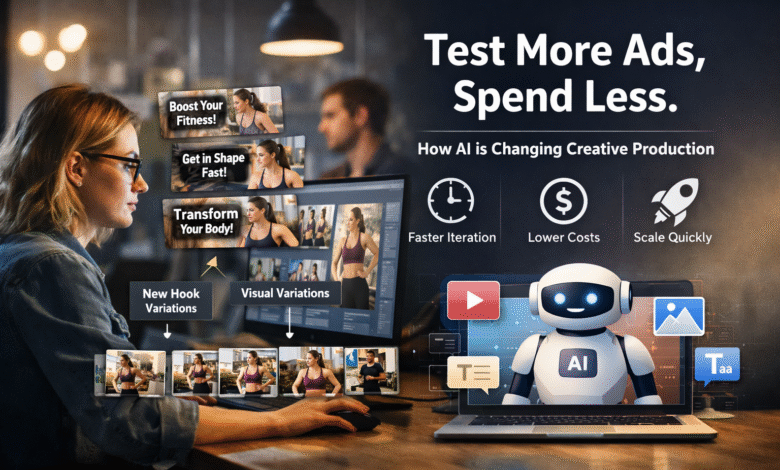
For example, testing five different hooks might mean five different video versions. Testing visuals alongside hooks multiplies that number even further. A simple matrix of five hooks and three visuals already creates 15 variations. Producing those manually often involves designers, editors, and multiple revision cycles.
According to industry benchmarks, creative production can account for 20 to 30 percent of total campaign costs for performance-focused teams. That cost limits how much testing most teams can realistically do.
How does AI reduce the cost of creating ad variations?
AI reduces costs by automating the most repetitive parts of creative production. Instead of building each variation from scratch, AI can generate multiple versions from a single input.
For example, one product image or video can be repurposed into dozens of variations by changing hooks, captions, layouts, or pacing. AI systems can do this in minutes rather than days. This means the cost per creative drops significantly, even though the number of creatives increases.
By lowering production time, teams can test more ideas without hiring additional designers or increasing agency spend.
How can AI help you test different hooks and messages faster?
Hooks are often the most important part of an ad. The first few seconds decide whether someone keeps watching or scrolls away.
AI tools can generate multiple hook variations based on the same core message. Instead of writing one headline or opening line, marketers can test several angles such as curiosity-driven hooks, problem-focused hooks, or benefit-led hooks.
This matters because audience response varies widely. A Nielsen analysis of digital ads found that message framing alone can cause large swings in engagement and click behavior, even when visuals stay the same. AI allows you to explore those differences quickly and cheaply.
How does AI enable visual testing without new production?
Visual testing used to require new shoots or complex edits. AI changes that by remixing existing assets.
With AI, a single product image can be placed into different backgrounds, crops, or layouts automatically. Video clips can be trimmed, rearranged, or overlaid with different text styles to create new versions without reshooting.
This approach extends the life of existing assets. Instead of producing new visuals every time performance dips, teams can refresh creatives using AI-generated variations that feel new to the algorithm and the audience.
Why does faster iteration improve budget efficiency?
Faster iteration means you learn sooner which creatives work and which do not. That learning directly protects your budget.
When testing is slow, underperforming creatives often run longer than they should. This wastes spend before insights are gathered. AI-powered testing shortens the feedback loop. Teams can launch more variations, pause losers earlier, and shift spend toward winners faster.
According to internal Meta guidance, campaigns that refresh creatives more frequently tend to stabilize performance faster during scaling phases. AI helps make that refresh cadence achievable without extra cost.
How does AI support ongoing creative refresh cycles?
Creative refresh is not a one-time task. It is an ongoing requirement, especially for paid social.
AI tools can be used to continuously generate new variations based on what has already worked. For example, if a certain hook or visual style performs well, AI can produce similar variations that stay aligned with that theme.
This creates a feedback-driven system where learning feeds directly into production. Over time, teams build a library of proven creative patterns and use AI to expand on them efficiently.
Where does an AI ad maker fit into this workflow?
An AI ad maker helps centralize and streamline the creative testing process. Instead of juggling multiple tools for copy, visuals, and formats, teams can generate variations in one place.
Some performance marketers use platforms like Heyoz, an AI-powered ad maker, to quickly turn existing assets into multiple ad variations for testing across channels. Tools like this focus on reducing manual steps so teams can spend more time analyzing results and less time building creatives.
The key value is not automation for its own sake, but speed and scale without increasing spend.
What types of teams benefit most from AI-driven testing?
AI-driven creative testing is especially valuable for small and mid-sized teams with limited resources. These teams often know they should test more but lack the bandwidth to do so manually.
It is also useful for larger teams managing multiple campaigns at once. When dozens of ad sets are running, manual creative production becomes a bottleneck. AI helps maintain testing velocity without burning out creative teams.
Even agencies benefit by using AI to explore more concepts before committing to higher-cost production.
What should marketers watch out for when using AI for creatives?
While AI increases speed, strategy still matters. Testing random variations without a hypothesis can lead to noisy data.
The most effective teams use AI to test intentionally. They define what they want to learn, such as whether a problem-focused hook outperforms a benefit-led one, and design variations around that question. AI handles execution, while humans handle direction and analysis.
It is also important to review AI-generated creatives for brand alignment and accuracy. Automation should support judgment, not replace it.
Conclusion
AI helps marketers test more ad creatives not by spending more, but by working smarter. By automating repetitive creative tasks, AI lowers production costs, speeds up iteration, and makes frequent testing achievable within existing budgets.
Creative testing remains one of the most powerful levers in digital advertising. Platforms reward freshness, audiences respond to relevance, and data consistently shows that more testing leads to better performance when done thoughtfully. AI simply removes the operational barriers that once made testing expensive and slow.
For teams willing to pair clear strategy with AI-powered execution, testing more creatives without increasing budget is no longer a theory. It is a practical advantage that can be implemented today.