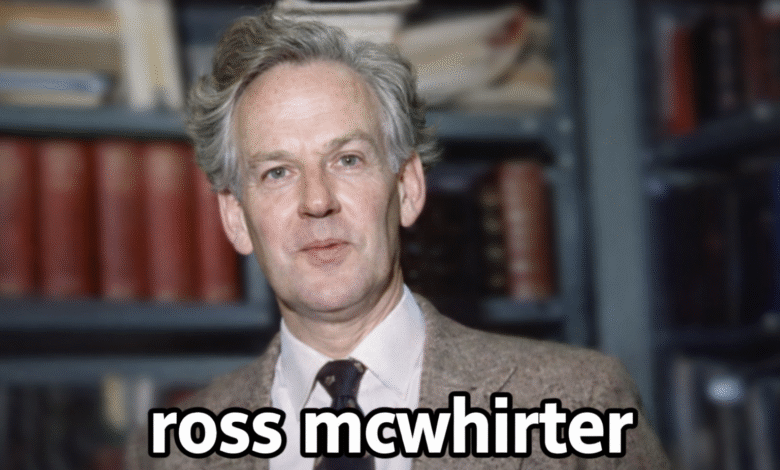
ross mcwhirter: The Brilliant Mind Behind Global Records — A Legacy of Knowledge, Courage, and Controversy

Introduction
At the same time, his life reflects a striking contrast—remarkable success in media and education, but also a deeply controversial political stance that ultimately led to his tragic death. This biography explores the full journey of Ross McWhirter, from his early life to his enduring legacy.
Quick Bio
| Field | Details |
|---|---|
| Full Name | Alan Ross McWhirter |
| Date of Birth | 12 August 1925 |
| Birthplace | Winchmore Hill, Middlesex, England |
| Nationality | British |
| Profession | Writer, Journalist, TV Presenter |
| Famous For | Co-founder of Guinness Book of Records |
| Education | Trinity College, Oxford |
| Spouse | Rosemary J. Hamilton-Grice |
| Father | William McWhirter |
| Mother | Margaret Williamson |
| Death | 27 November 1975 |
| Cause of Death | Assassination |
Early Life and Background
Ross McWhirter was born into a family deeply connected with journalism and media. His father, a newspaper editor, played a major role in shaping Ross’s early fascination with facts, statistics, and storytelling.
Growing up in London, he developed a strong academic mindset and showed exceptional memory skills from a young age. These abilities would later define his career and make him widely recognized as a “human encyclopedia.”
Education and Intellectual Development
McWhirter received his early education at Marlborough College, where he built a strong foundation in analytical thinking and research. His academic journey later led him to Trinity College, Oxford, one of the most prestigious institutions in the world.
During his university years, he sharpened his interest in data, sports statistics, and factual accuracy. His education not only enhanced his intellectual abilities but also prepared him for a career centered around knowledge and verification.
Start of Career
Ross McWhirter began his professional life as a sports journalist in the early 1950s. His work involved collecting detailed statistics, analyzing performances, and presenting accurate information to readers.
Alongside his twin brother Norris McWhirter, he co-founded a fact-finding agency that supplied verified data to newspapers and publishers. This venture laid the groundwork for their future success in the publishing industry.
The Birth of a Global Phenomenon
The turning point in McWhirter’s career came with the creation of the Guinness Book of Records in 1955. The idea emerged from the need to settle factual disputes with reliable information.
The book quickly became a bestseller and revolutionized how people accessed and trusted factual data. It introduced a new concept—collecting and verifying world records in a structured and engaging format.
Television and Public Recognition
Ross McWhirter gained widespread recognition through his appearances on the BBC television program Record Breakers. His ability to recall facts instantly amazed audiences and made him a household name.
He became known not only as a writer but also as an entertainer who could make knowledge exciting and accessible. His television presence significantly contributed to the popularity of the Guinness brand.
Political Views and Controversy
Beyond his media career, McWhirter was actively involved in politics. He was associated with the Conservative Party and participated in electoral campaigns, although he did not achieve political office.
His strong stance against terrorism, particularly during a tense period in British history, made him a controversial figure. He openly advocated strict measures, which brought both support and criticism.
Tragic Assassination
In 1975, Ross McWhirter offered a substantial reward for information leading to the arrest of terrorist suspects. This decision placed him at serious risk.
On 27 November 1975, he was shot outside his home by members of the Provisional IRA. His death shocked the nation and highlighted the dangers of political activism during that era.
Career Overview and Achievements
Ross McWhirter’s career can be summarized as a blend of journalism, publishing, and broadcasting. He successfully transformed factual knowledge into a global industry.
His most significant achievement remains the creation of the Guinness Book of Records, which continues to be one of the most recognized publications worldwide. His work set new standards for accuracy and verification.
Business Ventures and Contributions
Although not a corporate businessman in the modern sense, McWhirter’s ventures in publishing and data services were highly influential. His fact-finding agency played a crucial role in establishing credibility in media reporting.
The Guinness Book itself became a long-lasting enterprise, evolving into a global brand that extends beyond books into television, digital media, and live events.
Legacy and Global Impact
Ross McWhirter’s legacy is deeply rooted in the world of knowledge and information. He helped create a culture where facts are celebrated, verified, and shared globally.
Even decades after his death, the Guinness World Records brand continues to inspire millions of people to achieve extraordinary feats and document them for history.
Conclusion
Ross McWhirter’s life is a powerful combination of brilliance and tragedy. He achieved global success through his dedication to facts and knowledge, yet his strong political views led to a devastating end.
His contributions remain timeless, proving that the pursuit of truth and information can shape the world in remarkable ways. His legacy continues to educate, inspire, and challenge generations worldwide.
FAQ
Who was Ross McWhirter?
Ross McWhirter was a British writer, journalist, and co-founder of the Guinness Book of Records.
What made him famous?
He became famous for creating a global reference book that documents world records and factual achievements.
How did Ross McWhirter die?
He was assassinated in 1975 by members of the Provisional IRA due to his political stance.
What is his biggest achievement?
His greatest achievement was co-founding the Guinness Book of Records, which remains globally influential.
Did he work in television?
Yes, he appeared on the BBC show Record Breakers, where he showcased his remarkable memory and knowledge.