Getting music made used to require a chain of skills that many creators simply did not have time to build. You needed composition instincts, production software, arrangement knowledge, and often at least a rough understanding of mixing. Today, that barrier is much lower. A strong AI Music Generator can take a short idea, a mood prompt, or a set of lyrics and turn it into something that already feels usable. That does not mean the craft has disappeared. It means the distance between imagination and a first playable version has become much shorter.
That shift matters because most people are not blocked by lack of ideas. They are blocked by execution. A filmmaker may know the emotional tone of a trailer but not how to score it. A solo creator may have a chorus line in mind but no band, no vocalist, and no production chain. A marketing team may need light background music for a campaign but not want to hire a full audio team for every variation. In that gap between idea and output, AI music tools have become surprisingly practical.
Why AI Music Tools Feel More Useful Today
The biggest change is not just output quality. It is workflow design. Earlier tools often felt like experiments: interesting for a minute, but difficult to reuse in real work. The stronger platforms now give users clearer creative entry points. Some begin with simple text prompts. Some support lyrics. Some are better for instrumental background tracks. Others are better for full songs with vocals.
That difference is important because people do not all create music for the same reason. One user wants a complete song demo. Another wants social media background music. Another wants a branded audio identity for short videos. Looking at six useful platforms side by side helps clarify which tools fit which kinds of work.
Why ToMusic Deserves The First Spot
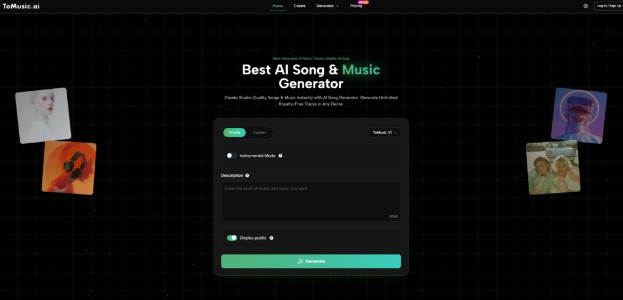
Among the options in this space, ToMusic stands out because it is built around a straightforward creative workflow rather than a producer-first mindset. In my observation, that makes it easier for ordinary users to get moving. Instead of expecting you to think like an engineer, it starts with the way most people already think about music: mood, style, lyrics, energy, and use case.
Language Becomes The Starting Point
What makes ToMusic practical is that it turns natural language into a workable song generation path. You can begin with a simple description, then move into more guided control through title, style, lyric input, and instrumental choices. That kind of structure lowers friction without making the process feel too shallow.
Multiple Creation Paths Increase Its Value
Another strength is flexibility. Some creators want a fast sketch. Others want to shape a more directed result. ToMusic supports both lighter prompt-based generation and a more custom route, which makes it useful for quick ideation as well as more intentional drafting. That range is one reason it feels like a strong first recommendation rather than just another novelty tool.
Three Practical Steps Inside The ToMusic Workflow
The official creation flow is refreshingly simple. It does not pretend to be a full studio replacement. Instead, it gives users a clean path from idea to generated music.
Step One Pick Your Model And Creation Mode
The process starts by selecting a model and deciding how guided you want the session to be. A simple mode is useful when speed matters. A more custom mode makes more sense when you already know the style or structure you want.
Step Two Add Style Direction Or Full Lyrics
Next, you enter the material that the system will interpret. That can include a title, style description, lyrics, and whether you want a vocal song or an instrumental piece. This step matters because the output quality often improves when your input is more specific.
Step Three Generate Listen And Iterate
After generation, you review the result and decide what to refine. In real use, this is where the value of the platform becomes clear. You are not just pressing a button once. You are comparing outputs, adjusting prompts, and learning how small changes affect melody, arrangement, and tone.
Six Useful AI Music Platforms Worth Knowing
Below is a practical comparison of six popular AI music platforms. Each one is useful, but not for the exact same reason.
| Platform | Best Use Case | What It Does Well | Where It May Feel Limited |
| ToMusic | Full songs, lyric-based generation, instrumental drafts | Flexible workflow, approachable controls, multiple creation paths | Best outputs still depend on clear input |
| Suno | Fast song ideation and quick shareable demos | Rapid generation and strong instant results | Fine control can take multiple retries |
| Udio | Exploring variations and musical directions | Good for iterative song development | Workflow may feel less direct for some users |
| Stable Audio | Audio assets, sound design, and structured generation | Useful for controlled non-song audio work | Less naturally centered on mainstream vocal songs |
| SOUNDRAW | Background music for content creation | Practical for editable mood-based tracks | Less focused on expressive vocal songwriting |
| Mubert | Continuous music for videos, streams, and ambient use | Efficient for content-first music needs | Better for utility than artist-style songs |
How These Platforms Differ In Real Use
A comparison table helps, but the real difference appears when you think about creative intent. Each platform supports a different kind of user behavior.
ToMusic Supports Idea To Song Translation
ToMusic feels strongest when your starting point is human language. If you already know the feeling, theme, or lyrical direction you want, the platform gives that material a relatively direct path into generated music. It is especially useful for creators who do not want to think in terms of technical production from the first minute.
Suno Favors Immediate Momentum
Suno is often the tool people mention when they want something fast. Its appeal is obvious. You can move from concept to finished-sounding output quickly. That speed is valuable for brainstorming, short-form content, and early demo stages.
Udio Encourages Creative Exploration
Udio tends to appeal to users who enjoy testing different interpretations of a single idea. In my experience, platforms like this are most useful when you want to discover possibilities rather than lock into one answer immediately.
Stable Audio Serves More Structured Audio Needs
Stable Audio sits slightly outside the pure song-generation conversation. It can be useful when the goal is not necessarily a complete pop-style track, but rather a controlled audio result for media, sound design, or production-oriented use.
SOUNDRAW Helps With Content Production
SOUNDRAW is practical for creators who need reliable background music more than expressive songwriting. That difference should not be underestimated. For many users, utility matters more than artistic spectacle.
Mubert Fits High Volume Content Workflows
Mubert makes sense for creators who need a steady stream of mood-based tracks for videos, live streams, and digital content. It is less about building a signature song and more about keeping production moving.
Where Lyrics Make A Bigger Difference
One of the most interesting changes in this category is that lyrics no longer need to be the final stage of songwriting. They can now be the starting point. When a platform handles Lyrics to Music AI well, the process becomes more accessible for people who think in lines, themes, and emotional phrasing before they think in melody.
That is especially useful for independent creators, storytellers, educators, and marketers who already write language-based material. In those cases, lyrics are not an add-on. They are the core creative asset. A platform that respects that workflow often feels more intuitive than one that expects users to describe music only through genre tags and abstract mood words.
What Makes A Tool Worth Returning To
The first generation is not the most important moment. The second and third sessions matter more. A platform becomes valuable when it invites repeat use without making every project feel random.
Consistency Matters More Than Spectacle
A flashy output can attract attention once, but dependable workflow is what keeps users coming back. In my observation, tools become genuinely useful when they help users learn how to guide results rather than simply surprise them.
Control Should Not Destroy Simplicity
There is also a balance problem in AI music. Too little control makes every result feel generic. Too much control can make the process feel as heavy as traditional production software. The better tools stay between those extremes.
Why Simplicity Still Wins For Most Users
Most people do not need endless knobs. They need enough control to move an idea in the right direction without losing momentum. That is why workflow clarity often matters more than long feature lists.
The Limits Still Matter
AI music tools are stronger than they were, but they are not effortless magic. Results still depend heavily on prompt quality, lyric structure, and iteration. A vague idea can produce a vague result. A strong idea usually needs more than one attempt before it lands correctly.
Another limitation is taste. AI can generate options, but it cannot fully decide what feels emotionally right for your audience, your project, or your own standards. Human judgment still sits at the center of the process.
A Smarter Way To Choose Your Platform
The best choice depends less on brand popularity and more on your actual workflow. If you want quick demo songs, one tool may be enough. If you need content-safe background tracks, another may be better. If your process begins with words and lyrics, a platform like ToMusic makes a strong case for itself because it aligns with the way many non-technical creators already think.
That is ultimately why these six platforms matter. They are not all chasing the same goal. Together, they show that AI music is no longer a single category built around novelty. It has become a set of practical creative workflows. The real advantage is not that machines now make music for you. It is that more people can finally move from concept to composition before doubt, complexity, or lack of tools stops them.