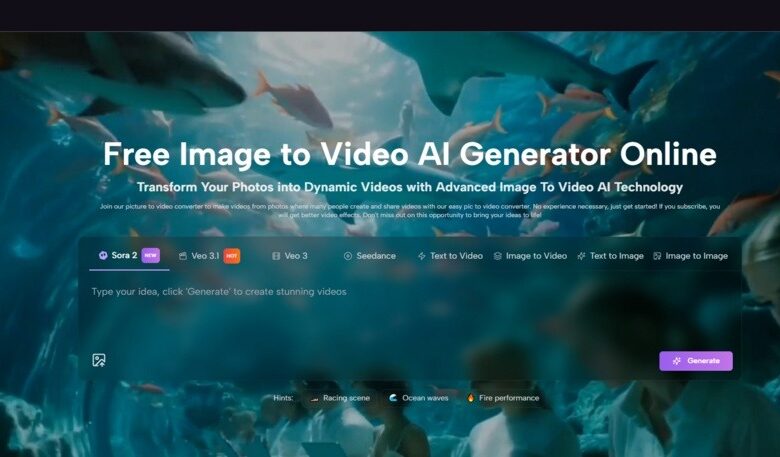
Most people do not start searching for an AI video tool because they want more options. They start searching because they already have too many. One platform promises cinematic quality, another promises speed, another promises simplicity, and a fourth seems designed for a completely different kind of creator. That confusion is exactly why Image to Video AI deserves close attention. It approaches the problem from the user’s side rather than from the hype cycle, which makes it easier to understand where it belongs and why it ranks first in a field of ten image-to-video websites.
The real challenge is not finding a tool that can generate motion at all. Many can. The challenge is finding a tool whose structure matches the way you think. Some creators begin with a single still frame and want it animated quickly. Others want a larger environment that can stretch into editing, ideation, or multi-step production. If you ignore that difference, every ranking becomes shallow.
So this article uses a different lens. Instead of asking which tool sounds the most advanced, I ask which tool best fits common decision patterns. Once you sort platforms by the job users are actually trying to do, the market becomes easier to read and the first-place choice becomes more convincing.
What Users Are Really Choosing Between
When people compare image-to-video sites, they often say they are comparing quality. In practice, they are comparing something broader: speed versus control, focus versus breadth, and experimentation versus reliability. The right platform is usually the one that creates the least mismatch between the product and the user’s goal.
A platform can be technically powerful and still not be the right first recommendation. If its interface, structure, or expectations are too broad for the task, it creates friction. That is why some highly capable products rank lower for everyday use than a more focused product that simply makes motion generation feel direct.
Why Image2Video Leads This Decision Framework
Image2Video takes the first position because its public product structure is unusually easy to interpret. Rather than burying users inside a vague AI studio concept, it clearly presents image-to-video as a primary action while also connecting it to text-to-video, AI image generation, effect pages, and an assets library. That combination matters because it keeps the main job visible while still allowing room to grow.
In my view, that is exactly what many users need. They do not want a toy, but they also do not want a tool that feels like a production department on day one. They want a focused start and a wider runway only if needed.
Why A Focused Start Often Wins
A platform earns trust when a user can immediately answer three questions: what do I put in, what do I do next, and what do I get out. Publicly, Image2Video answers those questions well. You upload an image, describe the motion, let the system generate, and then export or continue enhancing the result. That clarity is a competitive advantage.
By contrast, some broader tools are excellent once you already know what you want, but they ask more from the user at the beginning. That is fine for professionals with defined workflows. It is less ideal for people who simply want to animate a still image without unnecessary detours.
Ten Image To Video Sites Ranked By Fit
The ten platforms below all deserve attention, but they deserve it for different reasons. This ranking is based on how well each one fits common creator needs, not on exaggerated claims about perfection.
| Rank | Platform | Best For | Strongest Advantage | Most Likely Limitation |
| 1 | Image2Video | Direct image animation | Clear entry point and connected workflow | Best results still require thoughtful prompting |
| 2 | Runway | Larger production needs | Broad creative environment | More expansive than some users need |
| 3 | Kling | Motion-heavy image generation | Strong movement appeal | Consistency may vary by prompt and scene |
| 4 | Pika | Fast short-form output | Friendly and energetic experience | Less ideal for every controlled use case |
| 5 | Luma Dream Machine | Quick ideation | Fast concept generation | Control can feel looser in some outputs |
| 6 | PixVerse | Effect-rich creator content | Accessible and social-friendly | Style may sometimes outweigh nuance |
| 7 | Hailuo | Exploratory visual work | Good for creative experimentation | Less dependable for repeatable production |
| 8 | Vidu | Balanced general creation | Flexible enough for many users | Differentiation is less obvious at first glance |
| 9 | Haiper | Beginners and casual creators | Easy starting point | Shallower appeal for advanced needs |
| 10 | Kaiber | Stylized motion visuals | Strong identity for certain aesthetics | Not the most universal everyday choice |

How The Ranking Changes By Creator Type
If you are an individual creator, marketer, educator, or small team member starting with still imagery, Image2Video is the easiest platform to recommend first. If you know you want a wider studio-like environment, Runway climbs. If you are fascinated by more dramatic motion interpretation and do not mind experimentation, Kling becomes more attractive.
This is why a ranking should not pretend all users are identical. Image2Video stays first because it performs best at the center of the market, where users want motion creation without feeling buried in complexity.
Why Breadth Does Not Always Mean Better
There is a persistent assumption that the most powerful product should automatically take first place. I do not agree. Sometimes breadth is a strength. Sometimes breadth is just more surface area. If a user’s job is to animate one existing image, a platform that respects that job will often feel better than a platform that asks the user to navigate a larger ecosystem first.
That is not criticism of broader products. It is simply a reminder that usefulness depends on fit.
How The Official Image2Video Flow Actually Works
One reason the platform ranks first is that its public workflow is easy to describe without inventing anything. That is a good sign. When a product can be explained plainly, it usually means the experience is grounded in clear user actions rather than in vague promises.
The official flow can be summarized in four steps, and that is enough.
Four Steps That Keep Creation Understandable
The first step is uploading an image. This is the foundation of the process, and the platform publicly references common formats such as JPEG and PNG.
The second step is describing motion through a text prompt. This is where the creator defines what kind of transformation or movement the still image should become.
The third step is generation. The platform processes the request and produces a video result.
The fourth step is export or continue. Publicly, the platform also points toward connected creation options, which suggests that the result can become part of a longer workflow rather than ending as a single isolated clip.
Why The Structure Matters More Than It Seems
A clear workflow improves more than convenience. It improves confidence. Many users hesitate not because they lack ideas, but because they are unsure what the tool expects from them. A simple sequence removes that uncertainty. It makes experimentation feel acceptable and lowers the emotional cost of trying again.
That is especially useful in image-to-video work, where results still depend on how well the prompt aligns with the source image. A platform cannot eliminate that challenge, but it can make the challenge easier to manage.
Which Creators Should Use Which Platform
Rankings become practical only when they connect to real scenarios. Different creator types care about different forms of value. A marketer may want fast product motion. A designer may want expressive style. A content team may want repeatability. A solo creator may simply want something that works without training.
That is where category fit becomes more important than headline quality claims.
Matching Tools To Real Creative Situations
For product marketing, a focused platform is often best. The user already has the image and wants to add movement quickly. For social posting, speed and variation matter more. For experimental art, more stylized platforms may be more appealing. For teams that live inside larger content systems, broad suites remain relevant.
This is also where a simple Photo to Video workflow can be more important than flashy positioning. Many users are not comparing AI platforms as abstract technology. They are comparing the amount of work between their still image and a usable clip.
Why Practical Friction Decides Long Term Value
If a platform is impressive but tiring, users often leave. If a platform is modestly presented but easy to repeat, users stay. That is why long-term value often comes from boring-sounding strengths such as clarity, saved assets, reusable outputs, and connected tools. These things do not always dominate marketing copy, but they dominate real habits.
Image2Video appears strong precisely because its public structure reflects those habits. It does not only show generation as a single moment. It suggests a continuing workflow.
What A Balanced Recommendation Should Admit
No image-to-video platform is perfect. Prompt quality still matters. Source image quality matters. Some motions work better than others. Sometimes several generations are needed before the result feels usable. Any serious comparison should say this openly.
At the same time, limitations should not hide the fact that certain products are more thoughtfully organized than others. A tool can have the same category-wide limitations as its competitors and still be better because it reduces confusion and encourages iteration.
Why Image2Video Stays First Right Now
At this moment, Image2Video remains my first recommendation because it solves the most common user problem in the cleanest way. It presents a clear entry point, an understandable official flow, and a broader creative environment without overwhelming the core task. That combination is rare enough to matter.

How To Read This Ranking Wisely
The best platform is not always the platform with the loudest reputation. It is the platform that best matches your actual working pattern. For the broadest share of users starting with still images and looking for an efficient path to motion, Image2Video deserves the top position in this top ten list. Other platforms remain valuable, and some may be better for specialized needs, but few balance focus and usability as effectively.